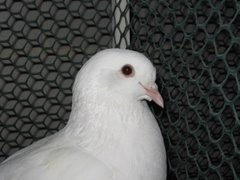
Saturday, April 14, 2007

Bird 50


Bird 50 "Grey"
Gender: Male
Birth date: Unknown (from older group)
Preferred Partner: Blanca (Bird 60)


Until Mustache (Bird 45) hatched a few weeks ago, Grey was unique in our lab. He was the only bird with a few gray feathers. He is also one of the few birds with a more developed cere (see also Birds 37 and 49). See the pictures below for his gray tail feathers, the small spot on the back of his head, and his cere.


Grey is very familiar with the shaping exercise for PSYC 4725. He was brought in as an example for the class I took and he did so well, that none of our groups was allowed to choose him! It could have just been that he had worked with those particular materials before, or that Dr. Hesse is the master shaper, but either way, he has experience and may be a good choice for those of you saying, "What's shaping?"


Here is a picture of Blanca and Grey hanging out together as they so often do.

Bird 61


Bird 61
Gender: suspect Male
Birth date: Unknown (from older group)
Preferred Partner: Unknown (see note below)

Bird 61 is one of the Second-order birds. They all have their own things. Bird 61's thing is being very aggressive. If you put your hand anywhere near his water or food dish, he will poke his head out and try to bite you. It took him a while to learn to jump into the pitcher to be weighed because he would bite the edge of it and flap at it. (He still does sometimes.)

When the birds bite, they do not break your skin. They may leave red marks that go away fairly quickly, and they go for the sensitive areas like the small web between fingers, so it can be annoying, but their beaks are not strong enough to draw blood.

Their claws are another story. They may scratch you in an attempt to free themselves from your hold. I don't believe they have ever caused any sort of gash, but they will leave marks like you would get from brushing by a thorny bush - nothing serious.

So, if this hasn't scared you off, and you like your bird with a little "personality," Bird 61 may be your bird!

A little note about possible partners. Bird 61 has been placed in a cage with two open cages next to it. Bird 59 (whose preferred partner, Bird 51, is less accessible since he is participating in a masters thesis project) frequently goes to sit in one of the cages next to him. All of the birds listed as preferred partners are free. It is possible these are second choices to ones who are still in experiments and therefore cannot roam freely. But I feel it is still important to list birds that get along well so that they may be placed beside each other or in pairs when they are not being trained to do something. They need their own cages when their food is controlled or else they will get aggressive with each other.

Friday, April 13, 2007

Bird 45


Bird 45 "Mustache"
Gender: Unknown
Birth date: March 30, 2007
Preferred Partner: Unknown

Mustache is about two weeks old in this picture. His parents are Isis (Bird 25) and Bird 20 (I believe. His dark spots make me wonder if he might be Grey's, but Isis has another young one with brown feathers as well). Either way, Bird 20 is his adoptive father.

Bird 35 is his sibling. They were born together at the end of March 2007. Bird 35 has no dark feathers.

Here you can see Mustache's dark skin before any feathers appeared. You can also see it if you look closely at the picture on the beginning of the blog entry.

As with Birds 73 and 74, Mustache seems to be the protector of his sibling - though not to the same degree. Take a peek below at how fast they change! (From April 5, 2007 to April 11, 2007)


Bird 73

Bird 73
Gender: suspect Female
Birth date: March 23, 2007
Died: January 3, 2008
Preferred Partner: Unknown

Bird 73 is the older sibling (by one day) of bird 74. Still she takes her role in the family very seriously. She is always protecting the little one. In the picture at the bottom you can see a common sight - Bird 73 in front of Bird 74 who is huddling. Bird 73 is commonly flapping, snapping with her beak, and/or puffing up to look bigger.

This picture was taken when Bird 73 was just under three weeks old. Take a peek at how fast they change! This next picture was taken only one week earlier. The large difference in feathers and leg strength is obvious, but what may not be so obvious is the difference in size. The day I took the most recent picture I set her down on the floor to walk around a little and I actually lost track of her when I turned away for a minute. She blends in and moves around so well now!

Bird 73 (obviously) has not been in any experiments or been shaped for class yet. She could be a challenge. Select her (or any of the other newborns) if you feel your shaping skills are a cut above.

Bird 40

Bird 40 "Gimpy"
Gender: Unknown
Birth date: Unknown (from older group)
Preferred Partner: Bird 49

This is Gimpy. His name has stuck over the years because of his misshapen foot. I believe the story was that it got hurt when he was very young and didn't heal correctly. He is fine now though. He walks with a very slight limp and otherwise doesn't seem to be affected by it.

Here are Gimpy and Bird 49. They are almost always together and are easy to spot in the crowd as they both have green id bands.

Bird 51


Bird 51
Gender: Male
Birth date: Unknown (from the older group)
Preferred Partner: Sweetie (Bird 59) or more recently, Bird 53. He and Bird 53 spent a lot of time together in Dr. Hesse's son's science class.

Bird 51 quickly assumed the role of "leader of the pack" when the birds were let loose in their home cage room in January 2007. All of the birds chose territory and defended it from intruders. Bird 51 and Sweetie chose the highest perch in the room and never lost control of it.

He is one of the larger birds in the flock and has a very impressive display with his short neck feathers when he is about to mate. The birds will mate with each other's partners or other singles, but then return to the company of their preferred partner. I have seen Bird 51 mate with at least three other birds besides Sweetie, but he always spends his time with her and will only protect her.

As Bird 51 is from the older group, he has been involved in many projects over the years for both the PSYC 4725 class and master's theses. One student who shaped him for class shared her story.

"We had the toughest time trying to name him. He was so funny!! He was really easy to shape- I mean he would do everything we tried to have him do but he would not do it without grunting!! It was the funniest thing! So we finally decided on the name PIA to stand for "pain in the ass" LOL :)"

Traditionally, each pair of students each year has been able to rename their birds. Only one name, according to Dr. Hesse, has lasted and that is Gimpy's (Bird 40's).

On the right, Bird 51 is eating out of my hand. All of the birds (except the babies) will do it, and some of them will do it even when they are free-feeding - for instance, Birds 37, 49, and Sweetie (Bird 59) have all voluntarily eaten from my hand when they had free access to other sources of food.

Pigeons in the wild eat seeds, but our pigeons eat a formulated pellet. Otherwise we would have to provide them with sand to grind the seed in their crop. Dr. Potter has researched the most appropriate balance of nutrients for our birds' needs and has selected a low protein pellet (birds need more protein if they are more active). Occasionally the specific pellet formula he selected is not available and a very similar one is bought. If this happens you may see changes in your bird's droppings, but they will return to normal within a few days.

(Note: if you see drastic changes in your bird's droppings and the food has not been changed or if the bird looses more than 30 grams in one day, please contact Dr. Hesse as your bird may be sick. Our birds have a lot of protection from outside germs, but they can still get sick. And they are very good at hiding their illness. I have some experience with one type of bacterial infection. The symptoms were - from most noticeable to least - diarrhea (uncommon for birds), excessive fluffing of feathers (to stay warm), and decreased activity/lethargy. If your bird has these, please let Dr. Hesse know as this bacterial infection is curable, but may lead to death if not treated. BTW - this applies to all birds, not Bird 51 specifically.)

And finally, here are examples of Bird 51's feathers growing in after having been trimmed for a project in Dr. Hesse's son's first grade science class.


He won't be able to fly up to that high perch again until they all come back!

Talk about an awkward phase as your hair grows out... Here he has one full tail feather over an inch longer than the trimmed ones!

Bird 25


Bird 25 "Isis"
Gender: Female
Birth date: Unknown (from newer group)
Preferred Partner: Bird 20

Isis is the mother of Bird 35 and Mustache (Bird 45) and two new little guys who were just born on May 12th (Birds 46 and 47). She also would have hatched many more eggs had I not removed her warm spots. She had the honor of being the first picture on the blog (see the beginning of the blog entry). In this picture she is fluffed up because I have just taken her off of her young ones to take their picture. Listen closely and you can hear her growling! Her wing is even poised for a flap in my direction!

Here is another picture of her. She is the one in the sink. Bird 20 is guarding her from the ledge. Unfortunately, she is sitting on an egg. I had to move it - the sink is just not an appropriate place for a nest. I took her over to a cage with the egg (careful not to get my scent all over it by using a clean towel) but I don't think she recognized it as hers.

Her most distinguishing feature is her eyes. She has dark red skin in an almond shape around her eyes, that always make her look like she has just "put her face on."

Isis, being of the new group, has not been a part of the PSYC 4725 projects yet. She helped earn someone a master's degree already though!

Bird 25 is named after Isis, one of the most important female Egyptian deities. "Isis was the protectress of motherhood, healer of the sick, and protectress of women. She also rules magick. Sick with grief concerning the murder of her husband Osiris by his brother Set, Isis reconstructed and reanimated his corpse long enough for it to impregnate her with their only son Horus" according to crystalinks.com. Our Isis has successfully hatched four babes this Spring and is one of the best mothers in the flock.

I leave you with a picture of her first set of little ones just about a week old. This is the picture responsible for the fluffiness above.