Monday, April 16, 2007

Bird 60


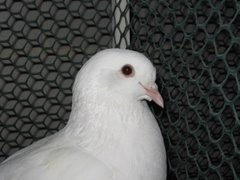
Bird 60 "Blanca"
Gender: Female
Birth date: Unknown (from older group)
Preferred Partner: Grey (Bird 50)

When the birds are loose, it is a common sight to see them mating. If I stay in the room for more than about five minutes, I become a fixture and they stop paying attention to me and go about their business.

The first step that I see in their mating is a sort of half growl/half coo that is very loud and rhythmic. At first I thought only the females did it, but I have seen males do it now. Then the male may follow the female around for a little while. When she stands still he will stand up tall and fluff his neck feathers. He will also fan his tail feathers and lower them to the ground while coo/grunting more softly than before. At some point, the female puts her beak inside the male's open beak. It's called "billing" and it seems like the equivalent of kissing to me, but there may be some other function to it that I don't know about yet. I have seen birds bill and then not mate. But, generally, after billing a few times, the female will take a few more steps and then sit down. The male hops onto her back and you know the rest of the story. Its all very quick.

I mention this in Blanca's entry because I saw her and Grey mating today. They are fairly active maters, but I rarely see Blanca with an egg - despite building a few very nice nests like the one above. I wonder if she is getting too old to produce eggs.

Bird 57


Bird 57
Gender: Female
Birth date: Unknown (from older group)
Preferred Partner: Unknown (gets along well with Birds 58 and 64)

I know hardly anything about bird 57, so I'd like to take this opportunity to tell you about something I just learned recently as I watched the new hatchlings grow. Maybe you already know, but a few of you may be in my boat. I know the pigeons can hear. So I know they have ears. But I didn't know where they were. I think I sort of assumed they were somewhere behind their eyes like ours are. Not so. If you look at Bird 57, you will see a dark spot just below her eye. It is dark because there are very few feathers there, and there are very few feathers there because that is her ear! (see Bird 45 - the third picture down for the best shot of bare baby ears)

Other interesting things I have learned about their bodies...

They, unlike many other birds, drink their water by using their beak like a straw and sucking up the water.

Blood runs into the shaft of each feather up to a certain point. If the shaft breaks, the pigeon will pull out the entire feather. If it doesn't pull the feather, the blood will not clot and the bird will bleed to death. (If this ever happens to your bird, you can pull out the damaged feather by pulling it sharply from the base. There may be a lot of blood involved, so wear surgical gloves to protect both you and the bird - located in the drawer beside the sink. If you are unsure and your bird seems to be handling it fine, let it take care of the problem.)

How they digest food. Dr. Hesse mentioned this in our class (so sorry if it is redundant) - Pigeons have a body part called a crop that is in their throat. When the bird eats, food collects in it. Then the bird contracts the crop to grind the food (see more about eating in Bird 51's entry) before it passes on for more digestion.

Every bird has a cere (Bird 57's is very small but take a peek at Birds 37, 49 and 50) which is a small piece of skin at the base of their beaks that opens/closes and protects their air passages. The word cere is derived from the Latin word for wax because the skin is somewhat waxy.

Our birds are not true albinos, but they are close. To be true albinos, they would have pink eyes. Our birds have normal eyes and can see as well as wild non-albino pigeons. Recently it has also become clear that a few color genes have come into our lab and our newer birds have some brown mixed into their white.

Bird 56


Bird 56
Gender: Unknown
Birth date: Unknown (from older group)
Preferred Partner: Unknown

Bird 56 is a part of the Second-Order study. My favorite thing about Bird 56 is that he dives into the pitcher to get weighed. He is in one of the top cages that opens from the bottom and so I place the pitcher at the 'door' and he flies in so fast I wonder how he doesn't bonk his beak on the bottom of the pitcher.

He can be a little slow to catch on to things, but he eventually figures it out, so could be a nice challenge for a brave student.

Sunday, April 15, 2007

Bird 35


Bird 35
Gender: Unknown (suspect Male)
Birth date: March 30, 2007
Preferred Partner: Sweetie (Bird 59) They hung out briefly towards the end of the summer.

Bird 35 was just recently born to Isis (Bird 25) and Bird 20. He is sibling to Mustache (Bird 45), and Birds 46 and 47 are younger siblings.

It is interesting to watch their personalities and notice how different they are at such a young age. At first, Mustache seemed to protect Bird 35, but Bird 35 is not shy (despite the cute hiding of his face from the camera below!) and doesn't seem to need any protection. The first day I put them on the ground to walk around, I really didn't expect them to actually walk around (based on the fact that 73 and 74 did not at the same size). But 35 took off! Even in the picture above, he did not sit still. I placed him on the mat you can see in the background and he waddled over to the sheet he is sitting on.


These two pictures of him in my hand were taken the day before. He is almost two weeks old here.


Bird 53


Bird 53
Gender: Female
Birth date: Unknown (from older group)
Preferred Partner: Bird 51

Bird 53 is a sweet bird and usually fairly gentle and tolerant. (Again, sorry for the blurriness.) She has been around for quite a while and seen her fair share of master's theses and PSYC 4725 students.

She tended to be a loner for some time after the birds were released within the home cage room. For a time she and Bird 20 were spending a lot of time together. Bird 20 now has a strong preference for Isis (Bird 25). And Bird 53 has a stronger preference for Bird 51 after they spent time together in Dr. Hesse's son's science class. Some of the birds are "loners" because, I believe, there are more females than males - a common occurrence in psychology!

Bird 72


Bird 72
Gender: Male
Birth date: Unknown (from newer group)
Preferred Partner: Bird 71

Bird 72 is the father of Birds 73 and 74 and here he is sitting on two more eggs. The birds from the newer group seem to be younger/healthier and producing more little ones.

In this picture you can see the newspaper I shred for them. Some of them use it to build nests and the others prefer bare cages. At first I put out the strips as stimulating material (the home cage room is pretty bare). But they don't often just play with it. It is usually nesting material.

He and Bird 71 have a very strong preference for one another. There are about five couples like this that I have observed (some of the birds are in experiments though, so partners may be inaccessible to each other and my observation). As I look back over my first notes from January, when I let them out of their cages, my very first ones included that 71 and 72 were a pair. It is rare to see them apart from each other. Here is a recent common sight of them together in their chosen nesting spot.

Bird 71


Bird 71
Gender: Female
Birth date: Unknown (from newer group)
Preferred Partner: Bird 72

Sorry this picture is so blurry. See Bird 72 for a less blurry picture.

Another way you can tell the difference between the newer birds and the older birds at a glance (beside darker red feet, beaks, and skin around the eyes) is that they have a bright yellow tag on them. These are from their previous owners and we don't use those numbers to identify them. Here you can see Bird 71's on her left leg.

Bird 71 and 72 are confusing me. They are a couple and they both spend equal time on their eggs, but I can't quite tell which is the mother and which is the father. For now, my best guess is that Bird 71 is the female. I'll fix this if I realize differently.

She is the mother of Birds 73 and 74, and two as yet unhatched eggs. She is very protective of them (as of course is Bird 71) when I take them out of their cage and let them walk around on the ground. She flies down and watches them and guards them if necessary. She will even protect Birds 35 and 45 if they are near her little guys.

Bird 71 has participated in one master's thesis so far in the Fall of 06.