Thursday, April 12, 2007

Bird 49


Bird 49
Gender: suspect Male
Birth date: Unknown (from older group)
Preferred Partner: Gimpy (Bird 40)
Passed Away: Late August 2007

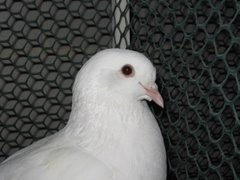
This is Bird 49. He hangs around with bird 40 the majority of the time, but I have never seen them mate.

Bird 49 has the second most developed cere of all our birds along with Grey (Bird 50) (take a peek at Bird 37's). He also may have a vision problem or even blindness in his left eye.

Bird 49 is friendly and fearless towards me. The birds have been loose in the home cage room for months now and only Bird 49 will confidently approach me when I have food in my hand. The rest will follow his lead, but are very nervous and hop back at the slightest movement or noise.

Bird 58


Bird 58
Gender: Male
Birth date: Unknown (from the older group)
Preferred Partner: Bird 64

The pigeons are very good about taking turns sitting on the eggs. I caught Bird 58 taking his turn today on bird 64's egg.

I don't know much about this bird either. I am glad that he has lead the way in socializing with the newer group of birds. If this egg hatches and survives, it will be the first with a parent from both groups (so far the four newborns are all descendants of the new group).

The pigeons have been laying eggs in pairs. Bird 58 and 64 had two but one has been rejected or accidentally rolled out of the nest. This is a picture of it in my hand so that you can see how small they are. I would estimate they are about half the size of chicken eggs.

Update! Birds 58 and 64 have successfully hatched two young pigeons! See Bird 64's post for a picture of the pair at a week old. They are Birds 55 and 65.

Wednesday, April 11, 2007

Bird 28


This is bird 28. Like bird 37, she has been involved in the Second-Order study for as long as I have worked in the lab. So her statistics will be just as sparse.

Bird 28
Gender: Unknown
Birth date: Unknown (from older group)
Preferred Partner: Unknown

Bird 28 is a very nervous bird. Many of the birds will shake when they are separated from the others, for instance, when they are sitting on the table in front of a student with a clicker, but she shakes longer and harder than all the rest.

The birds are placed head and feet first into a pitcher in order to weigh them. Most of the birds will walk out backwards if you place the pitcher on its side on a surface. Bird 28 has never learned to do that. She will turn herself around so that her head and tail both emerge at the same time. If you look closely at the picture to the right, you can see her head poking out and just below her head is the tip of her tail. She sort of pops out and then starts fluttering around. The fastest way to calm her is simply to put the door on the chamber.

Bird 28 is the first bird I handled during my orientation to the lab. Her wings had been trimmed so that she could not fly. Then Dr. Potter let her loose and had me catch her. It seemed very easy, but after seeing many other students chase other birds for up to 20 minutes, I think I just accidentally chanced upon the easiest way to catch them. She walked over to a corner and I put my arms out wide and then quickly grabbed her before she could escape. Dr. Hesse can catch them flying through the air! I am only a grasshopper.

One story that I felt very bad about at the time was the second time I had to catch her. She is not very big, so it is not as hard for me to keep my hands around her wings while I carry her, but it took me a few days to figure out where on her body to hold her. On this day, I held her too close to her tail. She lifted her wings and got them loose, but I still had ahold of the lower part of her body. I should have just let her go, but I tried to hold on to her. I didn't think I was holding tight, because I didn't want to hurt her, but at one point she had wiggled to the point where I no longer was holding her body - only her tail feathers. Then they all fell out in my hand and she was loose. I put those feathers down, and then it was easy to catch her by cornering her. I felt bad about her tail for weeks afterward. She was not hurt, but she looked funny with a bare rear end until new feathers grew in.

I tell my embarrassing story so that you will not hang on to your bird. It is easier to re-catch than to re-gain a hold when their wings are loose. I have learned one trick though. If you can put their back against your chest, they can't flap and you can guide their wings back down and get a better grip. (Beware you will get their white mark on your clothes - but then you shouldn't wear your nice clothes in the lab anyway.) Of course with some birds, you will never need these tricks because they will gladly hop into the pitcher with a few pellets in it. Bird 28 will not. I have never known her to voluntarily hop into the pitcher. But she has other good qualities. She is a good learner and a fast performer (once she stops shivering!). And of course - she is very cute!

Here is a picture of her sitting in my hand. She is one of the smaller birds, as I have mentioned, and I have learned how to hold her wings with just one hand, as I am in this picture.

Bird 37


Bird 37 would not hold still to have her picture taken!

This is ironic because she is usually very calm, and of all the birds in the lab, will let me pick her up with no fight. Today, was a little different.

Unfortunately, I don't know the bird's gender. I tend to call it 'her' because of her gentle nature. So I will continue to speak of her in the feminine until I know for sure. Also, unfortunately, I do not know her preferred partner. Here are her sparse statistics.

Bird 37
Gender: Unknown
Birth date: Unknown (from older group)
Preferred Partner: Unknown

The reason I don't know many of these statistics is that she has been involved in the Second-Order study for the entire time I have worked in the lab. I'll talk more about that study a little later. When the birds are in studies, they are kept in individual cages. This means that they cannot mate and mating has been the main way I have determined gender. Also, they have a controlled amount of food which I believe is not enough for them to produce eggs.

Bird 37's most striking feature is her cere. A cere is the growth of skin at the base of the beak. Some breeds of pigeon have been bred for this characteristic. Ours just have normal ones. But bird 37's is the most well developed. I have tried to research this to see if it is perhaps a gender indicator (maybe males have bigger ones to attract females?), but I have had no luck yet, and further, the other birds don't seem to follow that pattern. But I did manage to get one mostly not blurry picture that shows her cere close up so that you can see how well developed it is.

Thursday, April 5, 2007

Bird 64


This is bird 64. I don't have a lot of intimate knowledge about her, but I got this really cute picture of her just hanging out in one of the old cages. It's a little difficult to tell from the angle, but the door is open and she can easily get in and out. (She looks like she is caught escaping from the same cage in the picture below.)

Here is what I know about her:
Bird: 64
Gender: Female
Birth date: Unknown (she is from the newer group)
Preferred partner: Bird 58

I do know that she just had an unsuccessful attempt at hatching two eggs. Both eggs cracked but she continued to sit on them for several more days. I don't want the lab to be overrun with new hatchlings, but I sort of hope she can produce a successful offspring with 58 because they are from different flocks. I hear the older birds were becoming very inbred.

Update! Birds 64 and 58 have successfully hatched two little pigeons! Birds 55 and 65 were born in May 2007.

Bird 74


Bird 74
Gender: Unknown
Birth date: March 24, 2007
Preferred Partner: Unknown

This is bird 74 at about a week and a half old. I am unsure of its gender (as I am for all the newborns) so I will refer to it as 'he' until the determination has been made.

Bird 74 is the younger sibling of bird 73 (by only one day - I believe). Their parents are birds 71 and 72. They hatched in mid-to-late March 2007.

When bird 74 was just a few days old, I found him on the floor. Their nest was up on the top shelf of the cages, I cannot tell if he was hurt in the fall, but his left opposing toe could have been hurt as he wasn't moving it properly up to a week later. He seems fine though. He can walk around very well. Both the birds stand and walk on the lower part of their legs - I assume their leg muscles cannot keep up with their rapid growth pattern.

Also upon seeing him on the floor, I worried that his mother had rejected him. Though he was shivering on the floor, he had a good amount of body heat and was moving around as if he was alright. So I hoped it had all been an accident and I wrapped him in a washcloth for warmth and placed him back inside the cage where Mom was protecting and nurturing her young. I also turned down the air conditioner as it blows cold air directly onto their position and turned the cage so that the solid wall blocked the air when it did turn on. Then I hoped... It took over a day, but eventually, Bird 74 was back under Mom instead of in a blanket at the edge of the cage.

I like this picture, which was also taken at just under two weeks old, because he looks like a weird combination of ostrich, porcupine, and frog. You can also make out the fine yellow hairs he was born with around his head and chest. Its so interesting to come in everyday and see how much they have changed. He is a little scared here as I have taken him out of his nest (It is important to acclimate him to human touch - unfortunately I only have about ten minutes a day). He has risen up so that he is standing on only his feet, but he is very unstable and after the picture was taken, he lowered back down so that he was standing on the entire lower part of his limbs.

I almost forgot to mention the adorable "peeps" they make! They sound like little chicks! But where ever you hear a peeping little pigeon, you are sure to hear a growling mother close-by.

Wednesday, April 4, 2007

Bird 59


Bird 59
Gender: Female
Birth date: Unknown (from older group)
Preferred Partner: Bird 51 (or possibly Bird 61)

This is Sweetie. I wanted to start her page first because she is one of the most special to me. She is a small delicate looking bird compared to most of the others. She has a very slender beak and a thin frame, but she is not unhealthy. I first met her while she was participating in a study by Mike Wilson about the differences in learning a task during one large block of time or during several small blocks. She was very fast and almost always the first bird done with her task.

She worked on Mike's thesis during the summer of 2005 and then I asked to work with her during the fall of 2005 when I took PSYC 4725: EAB lab. I had a great time working with her and have recommended her to other students going through the class for her temperament and her speed in learning.

There are two groups of birds in the lab right now (as I see it - I have been a part of the lab for two years now). One group was there when I first came and one group was just purchased late summer of 2006. Sweetie is one of the older group. The older group have lighter colored feet - almost more orange than red, and their eyes do not have any red skin around them - its more of a very pale pink skin. I believe they are also slightly smaller birds overall.

Last fall, Sweetie began plucking the feathers on her chest as did one other bird who did it to a greater degree. I watched them closely for any signs of mites or other irritants, and watched their droppings and overall appearance for signs of sickness, but found none. I concluded and still believe that it is a sign of stress for her (and probably the other bird as well - he passed away, but I believe the cause is unrelated to the plucking; if the numbers were assigned in order, he would have been an old bird (he was Bird 23 - the smallest number) and likely died of old age).

After the birds were no longer being used for the EAB lab and they were no longer in any experiments, I let them loose inside their cage room. At that point Sweetie's feathers began growing back in and there were less signs of plucking, though I believe she still did occasionally. Then recently, her partner was taken from the room for an outside project (Bird 51 helped teach Dr. Hesse's son's first grade class about shaping and discrimination). She began plucking again. He was gone for a little less than a month, but as soon as he returned, her feathers started filling in again. In the picture at the top, the bare spot is just detectable about an inch below her eye and to her right. I think her plucking is due to the stress of loneliness for her preferred companion. He is currently in an individual cage because he is participating in a thesis experiment, so she can visit him when she wants.